
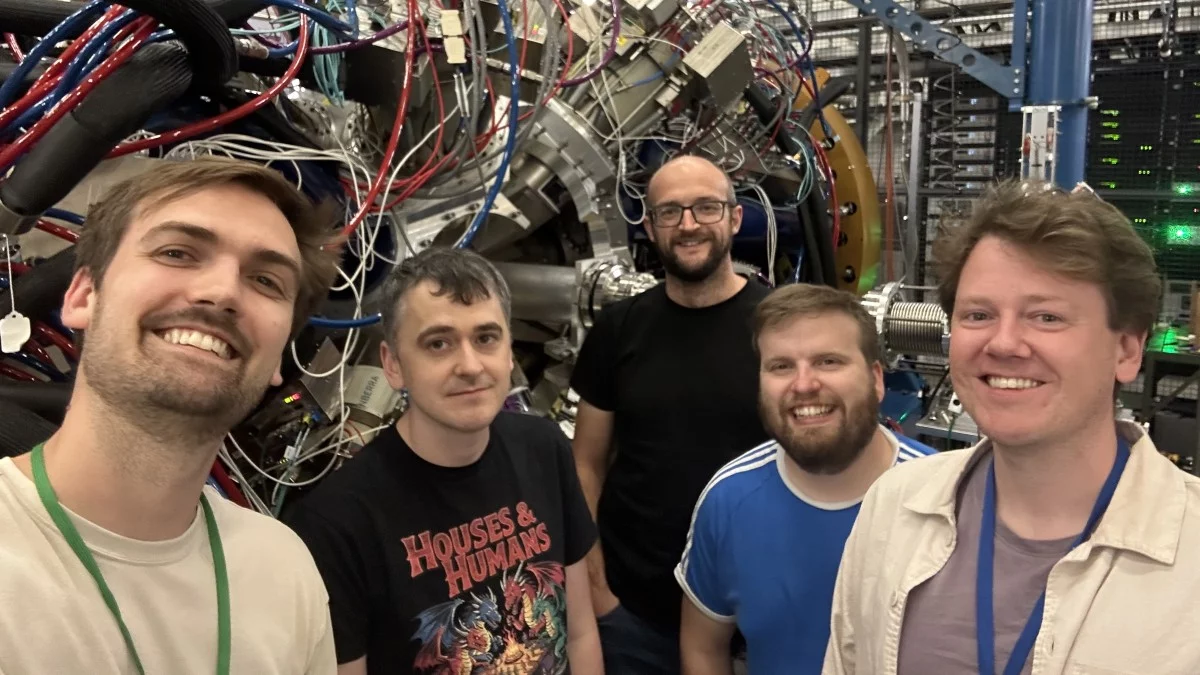
Nuclear physicists at the University of Surrey have become the first to carry out a scientific experiment using the world’s most advanced gamma-ray spectrometer – investigating a sudden change in the shape of the atomic nucleus that could challenge existing theories.
The experiment took place at the Facility for Rare Isotope Beams (FRIB) in Michigan, USA, using the newly delivered and characterised Gamma-Ray Energy Tracking Array (GRETA). Led by Lawrence Berkeley National Laboratory (LBNL) and delivered by a collaboration with Argonne National Laboratory, Oak Ridge National Laboratory and FRIB, GRETA is a $58 million detector designed to reveal the structure of atomic nuclei in unprecedented detail.
Working with collaborators from FRIB and Lawrence Berkeley National Laboratory, the Surrey team investigated a radioactive isotope of germanium to help answer a long-standing question about the shape of its atomic nucleus.
Read more here