
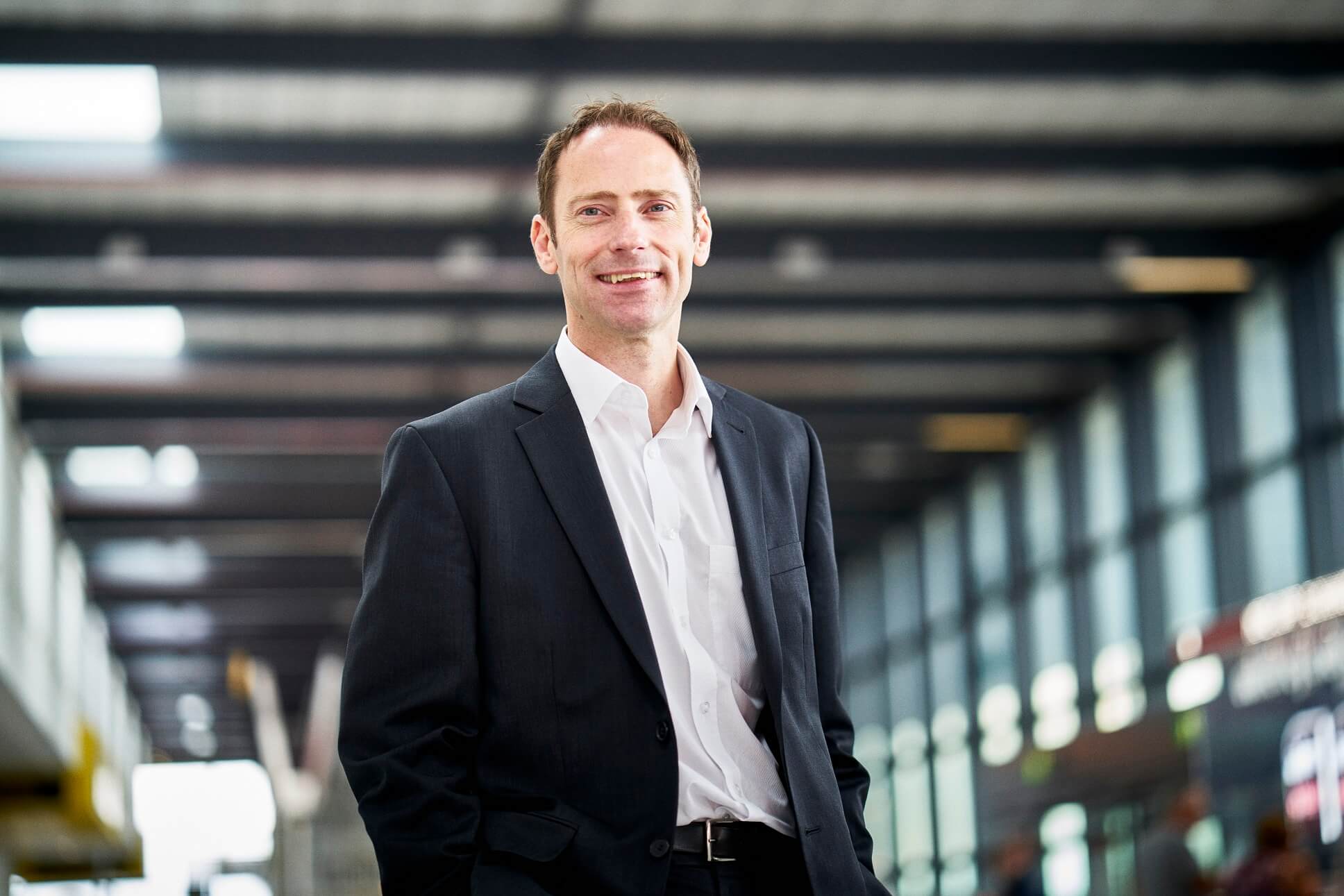
Tim Norwood admits he still gets excited watching the planes take off at London Gatwick. After more than five years working for the busiest single-runway airport in the world, you’d forgive him if the novelty wore off. But not a bit of it. Especially with such a compelling, prosperous future for the airport and the wider Gatwick Diamond region within grasp.
Gatwick Airport’s Director of Corporate Affairs and Planning has inspired a team that is shaping and collaborating on an ambitious vision to bring the airport’s existing Northern Runway into routine use. The plans aim to leverage the airport’s infrastructure to unlock new capacity and improve resilience, aligning with government policy.
Having successfully submitted its Development Consent Order (DCO) to the Planning Inspectorate (PINS), London Gatwick’s vision is set on bouncing back stronger after the COVID pandemic. Celebrating a return to profit in 2022, the airport – like many in the global travel industry – has overcome a tough financial period. Tim’s strategic leadership has played a crucial role in this resilience.
Click here to find out how you can play your part in the Gatwick Northern Runway Planning Process.
Tim joined Gatwick in 2017 as Chief Planning Officer and subsequently took on additional responsibilities as Director of Corporate Affairs and Sustainability. His experience extends to securing consent for major projects like the Hinkley Point C Project at EDF Energy and planning for a nuclear new build at Sizewell. With a strong academic foundation, including a Masters in Town Planning and a geography degree, Tim relishes the challenge of steering Gatwick towards a sustainable and prosperous future.
In this exclusive interview, we take a closer look at what Gatwick’s Northern Runway Plans mean for the region, the airport’s remarkable resilience after the pandemic, and Tim’s insights into creating a sustainable and thriving economic region for the future.
We’ll discover how:
- Gatwick Airport’s growth plans aim to boost the local economy by providing connections for leisure, business, and visiting purposes.
- The airport recognises that growth brings economic benefits, including the creation of 14,000 additional jobs and about a billion pounds into the local economy.
- Gatwick is committed to balancing growth with sustainability and minimising impacts on the environment, local road network, and noise for residents.
- Local businesses and regional stakeholders play a crucial role in shaping the airport’s plans and strategies, and their feedback is taken into consideration.
- Legacy and long-term planning are important for Gatwick, ensuring opportunities and skills for the next generation through programmes like apprenticeships and partnerships with schools.
- Resilience is achieved through efficient operations, learning from past experiences, and adaptability to changing circumstances.
- Gatwick is known for its innovative and efficient operation, embracing technology and sustainable initiatives to reduce carbon emissions and energy expenditure.
- The Gatwick Diamond region is a world-class business location with excellent transport links and a reputation for innovation, efficiency and productivity.
Tim, how will Gatwick Airport’s growth plan boost the local economy?
“Gatwick is a unique asset for the region. Our vision is to be the airport for everyone, whatever your journey.
“That vision has come about because we recognise that an airport allows opportunities, it allows connections, it allows you to go to places and visit different cities or countries that you might not have the opportunity to see. So, from my perspective, our growth plans are what makes Gatwick really exciting because we want to keep growing. We want to do it in a sustainable way. But we recognise that there are huge benefits from that growth for our local businesses.
“It’s not just the trade and the employment, but it’s about really making sure that businesses have the opportunity to expand and to export.
How will Gatwick Airport realise its plans for growth whilst prioritising sustainability?
“We know that the airport brings significant economic benefits to the area. Our expansion plans will create about 14,000 additional jobs in the region, and it will enable about a billion pounds of funds to go into the local economy. But with that, we know that the airport has impacts as well on the environment or on the local road network or, in particular, on noise.
“We’re very mindful that we need to try and limit and, where possible, reduce those impacts as much as possible for our local residents. We have a very innovative noise management board that looks to try and reduce noise.
“We know that there are environmental impacts associated with airports, but we also recognise that, as I say, the economic benefits are significant as well. So, it’s always a balancing act. ”
What role do local businesses and regional stakeholders have to play?
“We have lots of stakeholders that are interested in the airport. For us, it’s about making sure that the benefits of the airport get realised in the local economy. So, working with organisations like the Gatwick Diamond Initiative, or with the chambers of commerce, or with business groups, we can really understand what it is that they want from the airport. We can try and tailor our plans and our strategies to try and accommodate what’s right for them.
“Recently, we had an example of organisations saying to us, wouldn’t it be great to have a route into Germany? We brought Lufthansa into the airport to provide a daily service to Frankfurt. And that’s providing direct connections for some of our local businesses in the medical and pharmaceutical areas.
“So it’s feedback like that – working with the supply chain and working with our local businesses – that we can then work for the benefit of everybody and hopefully for their businesses to allow them to grow.”
What does legacy mean to Gatwick Airport?
“I’m a planner at heart. That’s my background. So, I always take a long-term view. Our master plan takes us to 2030 and 2040. The Northern Runway Project itself is a long-term strategic investment for the organisation.
“Of course, you have to react operationally on a day-to-day basis. But working on a strategic plan to improve the airport and to allow for opportunities for the next generation to make sure that those jobs are available, to make sure that they have the ability to have a whole host of skills – and a whole host of opportunities – is what really drives me to deliver these plans and to take them forward.
“We’ve got an amazing apprenticeship scheme – in the engineering department – which allows for a number of apprentices to complete a four-year programme at Gatwick. That will give them skills that they will take for the rest of their lives. We have a graduate programme where we take graduates from universities across the region to give them a two-year programme of working across the airport, again providing a range of skills and opportunities for them.
“We work very, very closely with local schools. By working with those schools, we can show what types of employment opportunities there are at Gatwick and the exciting prospects for them when they leave school.
Like other international airports, Gatwick is bouncing back from unprecedented recent global events. How has this experience prepared you for future resilience?
“Resilience is all about having a plan and being able to adapt your plan as well – so that it’s not so rigid that you can’t react to events that are happening. So, having a good plan but being efficient. If you are an efficient operation, that will then drive resilience. To us, resilience is about how quickly you can adapt to a changing circumstance or a changing situation.
“It’s important for us that when we’re in an operational environment, we are always looking to learn from what we did yesterday so that we can put those measures in place to improve the efficiency in the operation of the airport going forward. I think for all businesses, that’s a fundamental aspect of running a business, having a resilient operation.
How can the airport inspire others to follow Gatwick’s lead?
“Gatwick’s got a reputation for being innovative and having a really efficient operation. You don’t get to be the world’s busiest single-runway operation without embracing innovation and embracing technology. We are always looking for improvement, whether that’s in the security area with the introduction of AI technology with the new generation security scanners or whether it’s introducing sustainable initiatives to reduce our carbon emissions.
“I strongly believe that innovation is very important. You can’t ever stand still in airports. You’ve got to innovate, and we always want to be ahead.
What is so unique about the Gatwick Diamond region?
“The Gatwick Diamond is an absolutely world-class business location. And that is about having great transport links. Having Gatwick Airport in the heart of the region, it’s not called the Gatwick Diamond for nothing!
“More than that, the Gatwick Diamond area is just a great place to live. It’s got good transport connections, it’s got great countryside, it’s got some great towns, it’s got some great places to live, and actually, it’s just a really good location. I was told earlier on that Gatwick Diamond is the UK’s seventh largest economy in the UK. In terms of its output and the number of businesses that choose to locate here, we are punching well above our weight.
“And to me, that’s because the Gatwick Diamond area is known for innovation, it’s known for efficiency, it’s known for productivity, and it’s just got that reputation of being a very dynamic area, but also an area where people actually want to live, and people want to work.”